ANNE BRENNER
ANNE BRENNER

VISUAL ARTIST · PARIS
Life
leaves traces.
Painting, photography and fieldwork. Anne Brenner explores how living beings inhabit their surroundings, leave traces and are transformed through their contact with them.


CÔTE D’IVOIRE · 1990
Savanna
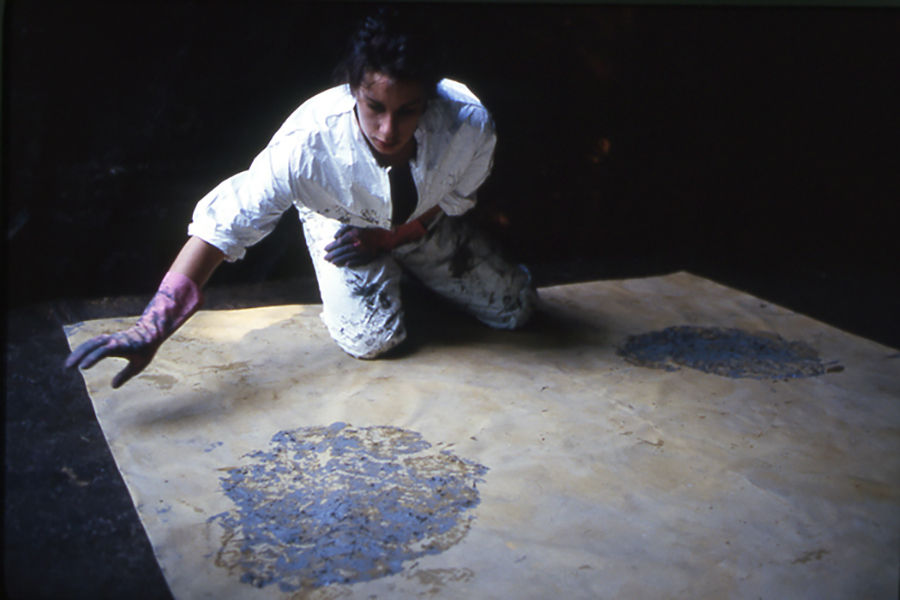
In 1990, I placed canvases on animal trails I had identified while tracking. I prepared their surfaces, then left them in the field. The visible traces are the material evidence of these passages.
Imprints of life

Elephant, warthog, hartebeest, termites. Acrylic and ash on canvas. 165 × 345 cm
An elephant family. Several passages in different directions.


Comoé Elephant. Acrylic and ash on canvas. 159 × 305 cm
An elephant family
Marahoué Elephant and Warthog. Acrylic and ash on canvas. 155 × 373 cm
Tracks of elephants, a warthog family and termites

Rhinoceros, termites. Acrylic and earth on stretched canvas. 150 × 163 cm.

Marahoué Elephant and Poacher. Acrylic and earth on canvas.
145 × 161 cm
A poacher’s footprint

Reading the terrain
Choosing a site begins with reading signs: tracks on the ground, displaced vegetation, mud on a tree trunk, fresh traces near water. Tracking determines where to place the canvas on a trail used by animals.
Looking for signs on the ground

Collecting a canvas in the field

Canvases covered with ash on an animal trail

Detail. An elephant footprint.

Field notebook. Rhinoceroses on the canvases.

The camouflaged canvas
To work on a hippopotamus trail, I camouflage the canvas with materials found on site. Its position and surface are adapted to the terrain and the animals’ movements.
A camouflaged canvas in the field, near water.

Preparing the canvas on the trail
Placing the canvas involves adapting it to the chosen trail and the surrounding vegetation.
Placing a canvas among the grasses, Côte d’Ivoire.

Collecting a canvas in the field.
%20transparent%20dos%20hippo%20totya%20144x158%20copie.png)
Two sides, one material
history
The canvas retains the mark of an event that took place in my absence. Traces of several passages may overlap. Both front and back bear the imprints of the terrain and the effects of the environment.
Tortya Hippopotamus, reverse, 144 × 158 cm
THE WORK ON DISPLAY
From the savanna
to the exhibition
The canvases bear traces of animals and of the conditions encountered in the field. Displayed in the exhibition space, they retain the history of those passages.

1992. Grenoble Natural History Museum. Solo
exhibition.
© 2026 Anne Brenner
PAINTING
The Vegetal Body
In these paintings, bodies take their place among plants. The painterly gesture reveals a figure and blends it into the vegetation. This interaction between the body and its surroundings suggests a relationship in which each seems to respond to and influence the other.

The Fern Trail, 2026. Diptych, acrylic and oil on canvas, 146 × 194 cm.

TreeBoy, 2024. Oil on canvas, 146 × 114 cm.

Above Us Only Sky, 2025. Oil on canvas, 35 × 27 cm.

The Crossing, 2024. Oil on canvas, 130 × 97 cm.

After the Dance, 2023. Oil on canvas, 146 × 97 cm.


Just a Breath, 2024. Diptych, oil on canvas, 146 × 178 cm.
Through The Blue Summer Days, 2025. Oil on canvas, 100 × 81 cm.


Almost Out of Memory, 2025. Oil on canvas, 97 × 130 cm.
At That Moment, He Would Remember His Dream, 2026. Oil on canvas, 73 × 92 cm.

Islands of Light Are Swimming on the Trees, 2025. Oil on canvas, 97 × 130 cm.
PAINTINGS ON DISPLAY
In the exhibition space
The installation view conveys the scale of the canvases and their presence in the gallery.

2025. La Lune en Parachute Contemporary Art Space, Épinal
© 2026 Anne Brenner
FIELD IMAGES AND STUDIO WORK
Animal Night
I set up infrared cameras along animal trails. They record the animals’ movements at night. These photographs form the starting point for work that I later develop in the studio.
01 · IN THE FIELD
Setting up the cameras

Installing a camera in the field, Abruzzo, Italy. Rewilding Apennines.

Camera mounted on a tree, Abruzzo, Italy.
Field images

Two wolves, infrared camera, Abruzzo, Italy © Anne Brenner

Deer, infrared camera, Abruzzo, Italy © Anne Brenner

Bear, infrared camera, Abruzzo, Italy © Anne Brenner

Bear, infrared camera, Canada © Anne Brenner

Young wolf, infrared camera, Abruzzo, Italy © Anne Brenner

Deer, infrared camera, Abruzzo, Italy © Anne Brenner
02 · IN THE STUDIO
A Secret Life of Animals
Working from the black and white photographs, I make transfers in the studio, then add paint. I photograph the resulting work to produce the final digital image.


A Secret Life of Animals #29, 2021. Digital print on Hahnemuhle paper, limited edition, 50 × 65 cm.
A Secret Life of Animals #7, 2018. Digital print on Hahnemuhle paper, limited edition, 55 × 55 cm.

A Secret Life of Animals #39, 2021. Digital print on Hahnemuhle paper, limited edition, 52 × 65 cm.

A Secret Life of Animals #41, 2019. Digital print on Hahnemuhle paper, limited edition, 55 × 55 cm.

A Secret Life of Animals #51, 2019. Digital print on Hahnemuhle paper, limited edition, 50 × 65 cm.
.png)
A Secret Life of Animals #49, 2019. Digital print on Hahnemuhle paper, limited edition, 50 × 65 cm.
© 2026 Anne Brenner
ON DISPLAY
Exhibitions

1997
L’empreinte
Centre Georges Pompidou

2019
Galerie d’Art du Parc
Trois-Rivières, Canada

2019
Meymac Contemporary Art Centre

2021
Abbaye de l’Escaladieu

2025
La Lune en Parachute
Contemporary Art Space, Épinal

Film shot in Kenya by Ushuaïa
Screening at Galerie d’Art du Parc
Trois-Rivières, Canada
Talks

2024
Rewilding Apennines
Abruzzo, Italy


2019
Université du Québec à Trois-Rivières
Canada

2016
Adelaide University, College of Arts
South Australia
© 2026 Anne Brenner
MEDIA
Selected Press
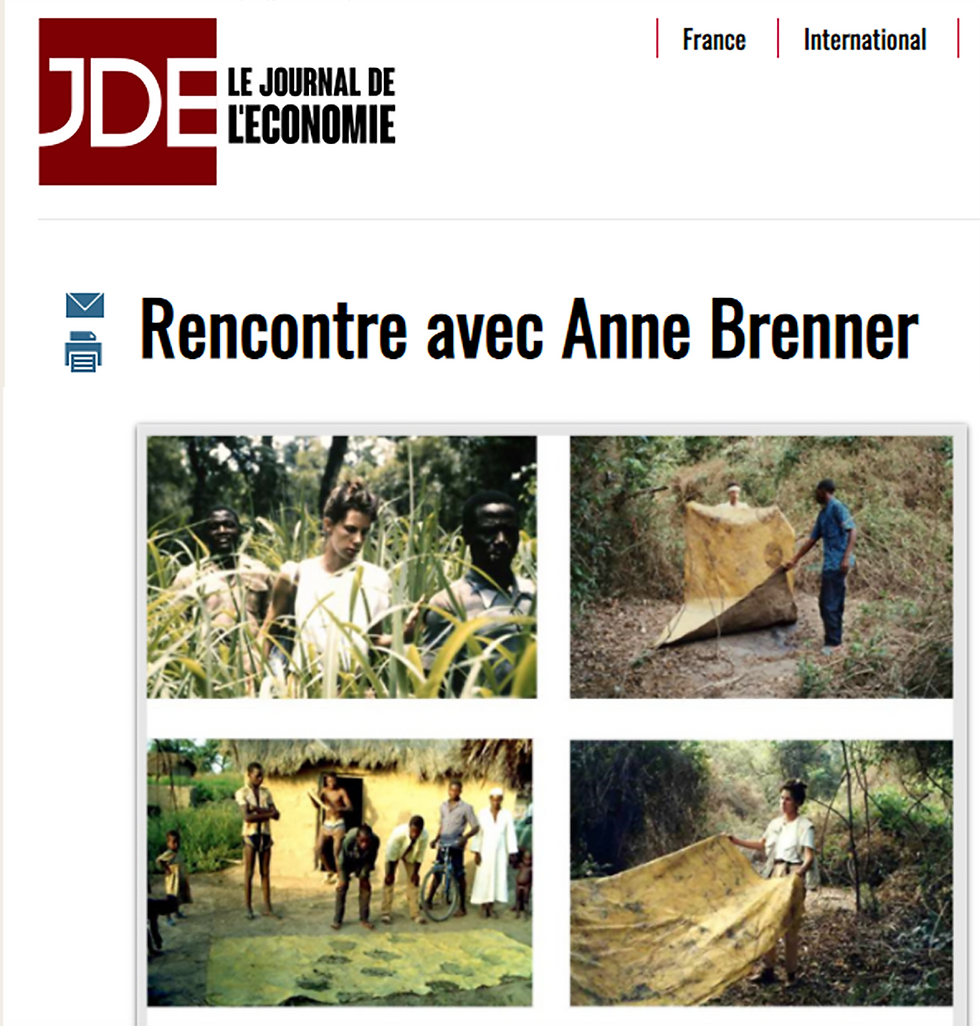
Click the logos and images to read the articles.




Selected Documentaries and Reports



ABOUT
Anne Brenner

Anne Brenner in her studio, 2026. Photo: Paolo Spada.
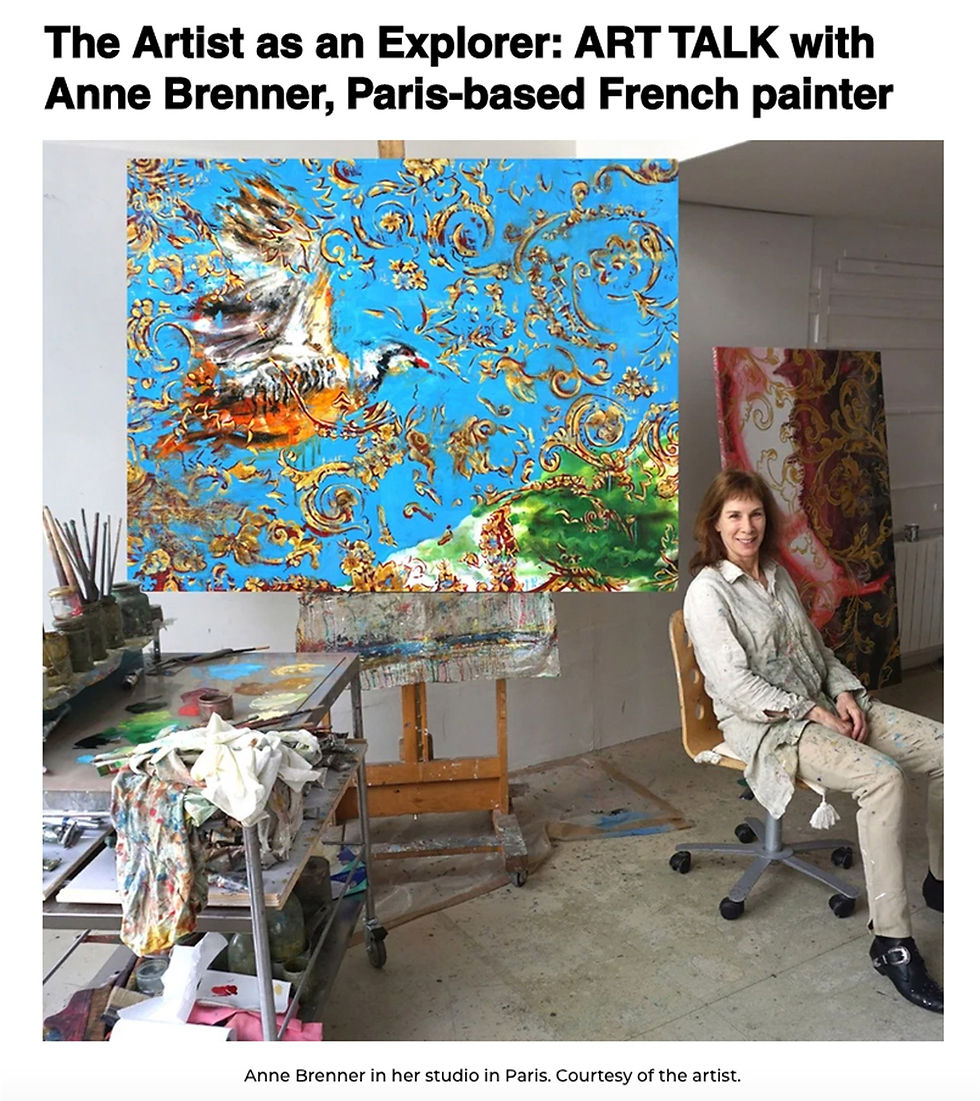
Anne Brenner is a visual artist who lives and works in Paris. A graduate of the École des Beaux-Arts de Paris, she also holds a degree in visual arts from Université Paris 1 Panthéon-Sorbonne. Through painting, photography and imprints, she explores the relationships between living beings and their environments.
In 1990, after completing her studies at the Beaux-Arts, she spent eighteen months in Côte d’Ivoire. She learnt to track animals and placed canvases on their trails. Their imprints, together with earth, rain, ash and insects, contributed to the making of the works in the series Savanna.
Her fieldwork continues today with infrared cameras set up to record bears and wolves as they pass. Installed and checked during extended stays in the field, these cameras provide a body of nocturnal photographs that she subsequently works on in the studio.
Her painting offers another relationship with the living world: bodies take their place among plants, and the painterly gesture brings figures into being as it blends them into the vegetation. Body and environment resonate with one another.
A recipient of the Léonard de Vinci grant from the French Ministry of Foreign Affairs, she has exhibited at the Centre Pompidou and the Cité des Sciences et de l’Industrie in Paris, Grenoble Natural History Museum, Meymac Contemporary Art Centre and the Royal Academy of Arts in London. She has also undertaken residencies with Rewilding Apennines in Italy, Pelican Lagoon Research & Wildlife Center in Australia, and La Mauricie National Park in Canada.


